


OM System OM-1 Mark II Mirrorless Camera Body
4545350056056
Couldn't load pickup availability
Order before 3pm for next day delivery
OM System OM-1 Mark II Mirrorless Camera Body
Rugged Micro Four Thirds Performance for Astrophotography
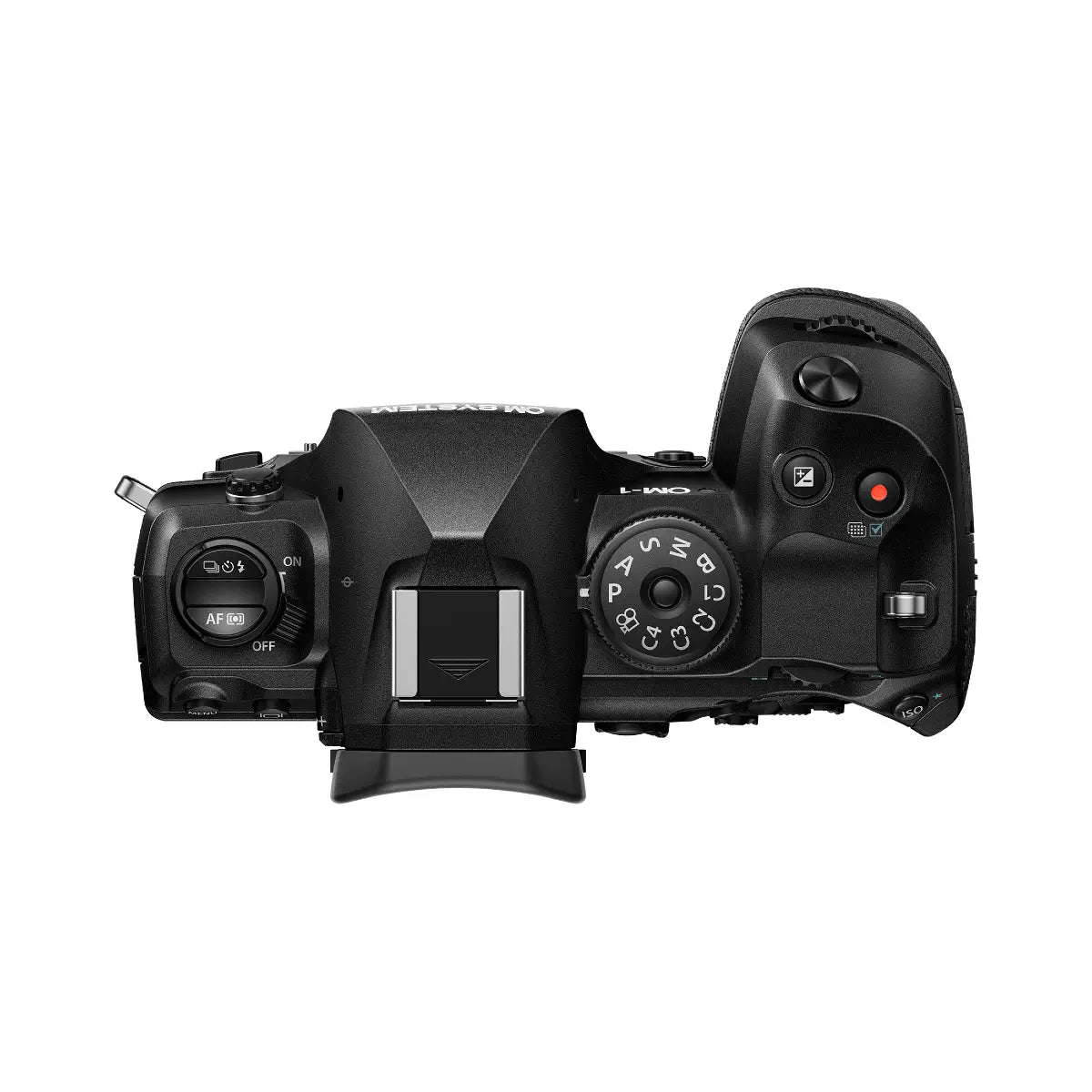
The OM SYSTEM OM-1 Mark II combines a 20.4MP stacked Micro Four Thirds sensor, powerful computational photography features and class-leading image stabilisation in a compact, weather-sealed body.
Its relatively lightweight construction, fully articulating touchscreen and extensive range of compatible lenses make it a versatile choice for photographing the Moon, nightscapes, star trails, astronomical landscapes and the Milky Way.
Key Features
20.4MP Stacked BSI Live MOS Sensor
The OM-1 Mark II features a 20.4MP stacked, back-illuminated Live MOS sensor paired with the powerful TruePic X image processor.
Its stacked design enables rapid readout speeds, responsive performance and high-speed continuous shooting. The sensor delivers detailed images while keeping the camera and compatible Micro Four Thirds lenses relatively compact.
Micro Four Thirds Format
The Micro Four Thirds sensor introduces a 2x crop factor compared with a full-frame camera. This effectively provides a narrower field of view from any given focal length.
That additional reach can be particularly useful for photographing the Moon, solar subjects with suitable certified equipment and other distant objects. For expansive Milky Way compositions, an appropriately fast ultra-wide-angle lens is recommended.
TruePic X Image Processor
The TruePic X processor supports the camera’s high-speed performance, advanced autofocus and extensive computational photography features.
Its responsive operation makes the OM-1 Mark II equally capable of capturing astronomical subjects, wildlife, landscapes and fast-moving action.
Micro Four Thirds Lens Compatibility
The Micro Four Thirds system provides access to a broad selection of compact OM SYSTEM, Olympus, Panasonic and third-party lenses.
Fast-aperture primes and ultra-wide-angle lenses are available for Milky Way photography and nightscapes, while longer telephoto lenses can be particularly useful for capturing the Moon within landscape compositions.
With an appropriate Micro Four Thirds T-ring and telescope adapter, the camera can also be connected to compatible telescopes for prime-focus photography.
Five-Axis In-Body Image Stabilisation
The OM-1 Mark II features an advanced five-axis in-body image stabilisation system offering up to 8.5 stops of compensation under supported conditions.
This is particularly valuable for handheld low-light, wildlife and landscape photography. For long exposures of stars, however, the camera should normally be secured to a sturdy tripod or tracking mount, with stabilisation switched off when appropriate.
Vari-Angle Touchscreen
The fully articulating 3-inch touchscreen can be positioned for comfortable viewing when the camera is aimed towards the sky, placed close to the ground or attached to a telescope.
Magnified live view and focus-assistance tools make it easier to achieve accurate manual focus on a bright star, the Moon or another distant target.
High-Resolution Electronic Viewfinder
The 5.76-million-dot OLED electronic viewfinder provides a detailed view of the composition, camera settings and captured images.
When working beneath dark skies, reducing the brightness of the viewfinder and rear display can help preserve night vision between exposures.
Computational Photography Features
Handheld and Tripod High Res Shot
High Res Shot uses the camera’s image-stabilisation mechanism to capture and combine multiple frames into a higher-resolution image.
Tripod High Res Shot can create images of approximately 80MP, while Handheld High Res Shot produces images of approximately 50MP.
Because stars move between the individual exposures, these modes are generally unsuitable for conventional untracked astrophotography. They can, however, be useful for detailed foregrounds, landscapes and carefully controlled stationary subjects.
Live Composite
Live Composite is one of the OM-1 Mark II’s most useful creative features for night photography. It records an initial base exposure before adding only newly appearing light to the developing image.
This makes it easier to create star trails, light-painting photographs and other extended night-time exposures while monitoring the result on the rear screen.
Live Bulb and Live Time
Live Bulb and Live Time allow the developing exposure to be viewed on the camera’s screen while the image is being recorded.
These modes can make it easier to judge the progress of a long exposure and stop it once the desired brightness has been reached.
Focus Stacking and Bracketing
In-camera focus stacking can combine up to 15 images captured at different focus distances, while focus bracketing offers much larger sequences for processing separately.
These tools are particularly valuable for macro, nature and product photography. Their usefulness for astronomical subjects is more limited because the night sky and foreground often require different exposure settings as well as different focus distances.
Live ND and Live GND
Live ND simulates the effect of a neutral-density filter, offering strengths up to ND128. The camera also includes Live GND for simulating a graduated neutral-density filter.
These features are primarily intended for landscapes and moving water rather than stars. Live GND can nevertheless be useful when balancing bright skies and darker foregrounds around sunrise, sunset and twilight.
Autofocus and High-Speed Performance
Cross Quad Pixel Autofocus
The OM-1 Mark II uses a Cross Quad Pixel autofocus system with 1,053 cross-type phase-detection points covering much of the image area.
This provides responsive focusing and tracking for wildlife, action and general photography. For stars and telescope-based imaging, precise manual focus using an enlarged live-view image will normally produce the most dependable results.
AI Subject Detection
Advanced subject-detection autofocus can recognise and track several types of subject, including birds, animals, people, cars, motorcycles, aircraft and trains.
Although these modes are not designed for stars, they make the camera particularly versatile for wildlife and nature photography during the same trip.
High-Speed Sequential Shooting
The OM-1 Mark II can capture images at extremely high continuous shooting speeds using its electronic shutter, including up to 120fps with focus and exposure locked.
High-speed shooting is not normally required for long-exposure astrophotography, but it can be valuable for wildlife, action and rapidly changing atmospheric events.
Blackout-Free Shooting
Supported high-speed sequential modes provide a blackout-free view through the electronic viewfinder, making it easier to follow fast and unpredictable subjects.
Video Capabilities
DCI and UHD 4K Recording
The OM-1 Mark II can record DCI 4K and UHD 4K video at up to 60p, providing detailed footage for astronomy presentations, observatory films, nature documentaries and educational content.
Its compact body and effective stabilisation also make it a practical option for creators working alone or travelling with a lightweight kit.
10-Bit Recording and OM-Log400
Internal 10-bit recording provides greater tonal and colour information than conventional 8-bit footage.
OM-Log400 offers additional flexibility for experienced filmmakers who want greater control when colour grading scenes containing bright foreground lighting and darker skies.
High-Frame-Rate Full HD
Full HD video can be captured at up to 240fps for slow-motion playback.
Although primarily intended for action and wildlife, this feature expands the camera’s usefulness beyond conventional night-sky photography.
Vertical Video Support
Vertical video information can be recorded for content intended for social media and mobile viewing, helping simplify the production of astronomy reels and short educational videos.
Practical Astrophotography Features
Interval Shooting and Time-Lapse
Built-in interval shooting enables repeated exposures to be captured over an extended period.
The resulting sequence can be used for star trails, image stacking or time-lapse films showing stars and clouds moving across the night sky.
Long-Exposure Noise Reduction
Long-exposure noise reduction can help minimise hot pixels and fixed-pattern noise. However, it requires the camera to capture an additional dark exposure of approximately equal duration.
For lengthy sequences intended for stacking, experienced astrophotographers may prefer to disable this feature and capture separate dark calibration frames.
Dual UHS-II SD Card Slots
Two UHS-II SD card slots provide flexible storage and backup options during extended photography and video sessions.
Files can be duplicated across both cards, recorded sequentially or separated according to file type, depending on the selected settings.
USB-C Power and Charging
USB-C charging and compatible external power support can help keep the camera operating during lengthy time-lapse sequences, extended video recording and overnight imaging sessions.
Cold temperatures, long exposures and prolonged use of the screen can reduce battery life, so spare batteries or a suitable external power source are recommended.
Compact and Lightweight Body
The OM-1 Mark II offers flagship performance in a body weighing approximately 599g with its battery and memory card.
Its relatively low weight is particularly helpful when travelling to remote dark-sky locations or building a portable setup around a compact tracking mount.
IP53 Weather-Sealed Construction
The camera is rated to IP53 when used with a suitably weather-resistant lens. It is also designed to operate at temperatures as low as -10°C.
This makes it well suited to outdoor photography in demanding environments, although suitable protection should still be used during heavy rain, substantial dew or severe condensation.
Additional Specifications
-
20.4MP stacked BSI Live MOS sensor
-
Micro Four Thirds sensor format
-
TruePic X image processor
-
ISO 200–25,600 standard sensitivity range
-
Extended sensitivity from ISO 80 to 102,400
-
Five-axis in-body image stabilisation
-
Up to 8.5 stops of stabilisation under supported conditions
-
1,053-point Cross Quad Pixel phase-detection autofocus
-
AI subject-detection autofocus
-
Up to 120fps electronic-shutter continuous shooting
-
Pro Capture functionality
-
80MP Tripod High Res Shot
-
50MP Handheld High Res Shot
-
Live Composite, Live Bulb and Live Time
-
Live ND up to ND128
-
Live GND simulation
-
In-camera focus stacking
-
5.76-million-dot OLED electronic viewfinder
-
3-inch vari-angle touchscreen
-
DCI and UHD 4K video at up to 60p
-
Internal 10-bit video recording
-
OM-Log400
-
Full HD high-speed recording up to 240fps
-
Dual UHS-II SD memory-card slots
-
USB-C charging and power support
-
Built-in Wi-Fi and Bluetooth
-
IP53 weather-resistant construction
-
Freeze-resistant operation down to -10°C
-
Micro Four Thirds lens mount
Ideal For
-
Lunar photography
-
Milky Way and wide-field astrophotography
-
Constellation and star-field photography
-
Star trails using Live Composite
-
Nightscapes and astronomical landscapes
-
Solar photography with suitable certified specialist equipment
-
Prime-focus telescope photography
-
Time-lapse sequences and image stacking
-
Portable star-tracking setups
-
Astronomy filmmaking and educational content
-
Wildlife, nature and outdoor photography
Explore the Night Sky with OM SYSTEM
The OM SYSTEM OM-1 Mark II combines a compact camera system with powerful stabilisation, rugged construction and some of the most useful computational photography features available for night-time shooting.
Whether you are creating star trails with Live Composite, photographing the Moon through a long lens or carrying a lightweight setup to a remote dark-sky location, the OM-1 Mark II provides the portability, durability and creative control needed to explore the night sky.
Shipping Options
Shipping Options
Returns Policy
Returns Policy


Does it come with a warranty?
What happens if I don't like it?
How fast is shipping?
What's the returns policy?
What are your opening hours?
Blog posts
-

From Sputnik to the Stars: A Timeline of Human Space Travel and Exploration
In less than 70 years, humanity has gone from sending...20 min read -

The James Webb Space Telescope: Our Incredible Eye on the Infrared Universe
From distant galaxies born shortly after the Big Bang to...9 min read -

10 Strange Facts and Cosmic Mysteries That Sound Completely Made Up
Space is far stranger than even the most imaginative science-fiction...7 min read -

How to See the International Space Station from the UK
Learn how to see the International Space Station from the...9 min readAstronomy for Families


